

On paper this is a straightforward style clash: a taller, longer range striker with a heavy output against a shorter fighter who wants the fight on the mat. But the tape on both women tells a more specific story than the measurements do, and it points toward the grappler.
Melissa Gatto
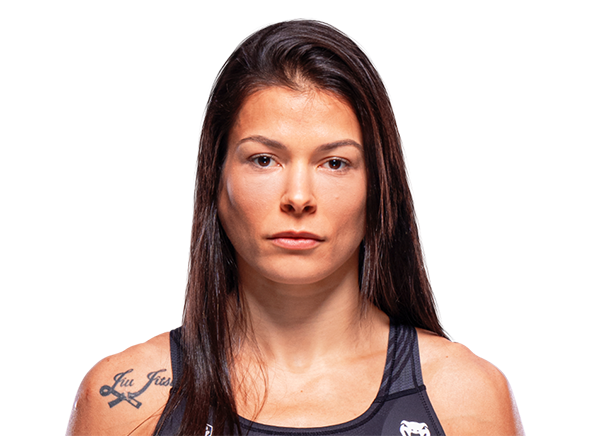
Gatto's path to winning rounds does not depend on landing a takedown clean. She gets to control even when her shots are stuffed, scrambling into top position or working from the clinch, and she averages 229 seconds of control a fight once she gets there. That number matters here because it sits right in the range Kareckaite has already given up to other control-minded opponents. Gatto's weakness is in the standup, where her tape shows linear retreats and late reactions when an opponent commits to a takedown attempt of her own. Her split decision loss to orthodox striker Ariane Lipski was a coin flip, and it came in exactly the kind of exchange Kareckaite wants to live in: distance striking with Gatto moving straight back. Where Gatto separates herself is once the fight hits the floor. She carries a submission level jiu jitsu threat, and her last two finishes both came off body shots, a detail that lines up badly for an opponent who fights with a static high guard.
Ernesta Kareckaite

Kareckaite's calling card is high output range striking, and she brings a two inch reach edge and a four inch height edge into this one, the kind of frame advantage that lets her pepper a shorter opponent from outside before they can close distance. She has banked rounds on volume even in fights she was losing position in, winning split decisions over Caliari and Judice despite spending real time underneath. That is the concern. She conceded 231 seconds of control to Barbosa, 214 to Caliari and 195 to Judice, and in each of those fights her tape shows the same pattern: a long fence pin, uneven takedown defense, and a habit of sitting in closed guard rather than standing back up. Her striking volume is real and it can still win her rounds against most opponents, but it has not stopped her from leaking control time against anyone who commits to taking it.
How the fight plays out
The swing question is simple: does Kareckaite's volume outscore the time Gatto spends in top position, or does Gatto's control phase simply override the striking exchanges the way it has against other high output opponents? The model leans toward the latter. Gatto does not need a clean takedown to get to her A game, and 229 seconds of average control a fight sits squarely inside the window Kareckaite has already conceded three times over, against Barbosa, Caliari and Judice alike. Once Gatto gets on top, Kareckaite's static high guard and her habit of staying in closed guard instead of standing up become real liabilities, especially against a fighter whose last two wins both came by body shot finish. The common opponent read does not tilt hard either way. Barbosa beat Gatto by majority decision and beat Kareckaite by unanimous decision, so that line is close to a wash. What breaks the tie is pattern over single data point: Kareckaite has now given up long control to three different opponents with three different styles, which reads as a repeatable hole rather than bad luck. Gatto is built to exploit exactly that hole, even if she has to scramble to find it rather than land a finishing takedown. Expect a fight where Kareckaite's output keeps her in range on the feet, but where Gatto's ability to convert scrambles into sustained top control, and from there into a body attack, is what the fight actually turns on.
The verdict
The pick here is Gatto. Her control game, which travels even without a finished takedown, lines up against a documented and repeated hole in Kareckaite's defense rather than a one off stretch of bad luck.
- Event · UFC Fight Night: Allen vs. Duncan · 2026-10-10 · Saturday, October 10, 2026 · 5:00 PM ET
- Market · Melissa Gatto -116 — recorded when the pick was posted
- Model · Bones, Botcappers' AI UFC / MMA model — how it is built and what it does not know
- Record · every pick is timestamped before the event and graded in public, win or lose
- Statistics · the model's own match/game database, current to the posting time above. Figures a reader cannot open here are internal to that database, not published third-party data.